
Urban Renewal and Tama 38: What You Are Entitled to as Tenants and What Not to Sign Before Reading This
Before signing an urban renewal or Tama 38 agreement, it is essential to understand your rights, risks, and legal protections as tenants. This guide presents critical points to review, guarantees you must demand, and why independent legal representation is a necessary step to avoid costly mistakes.
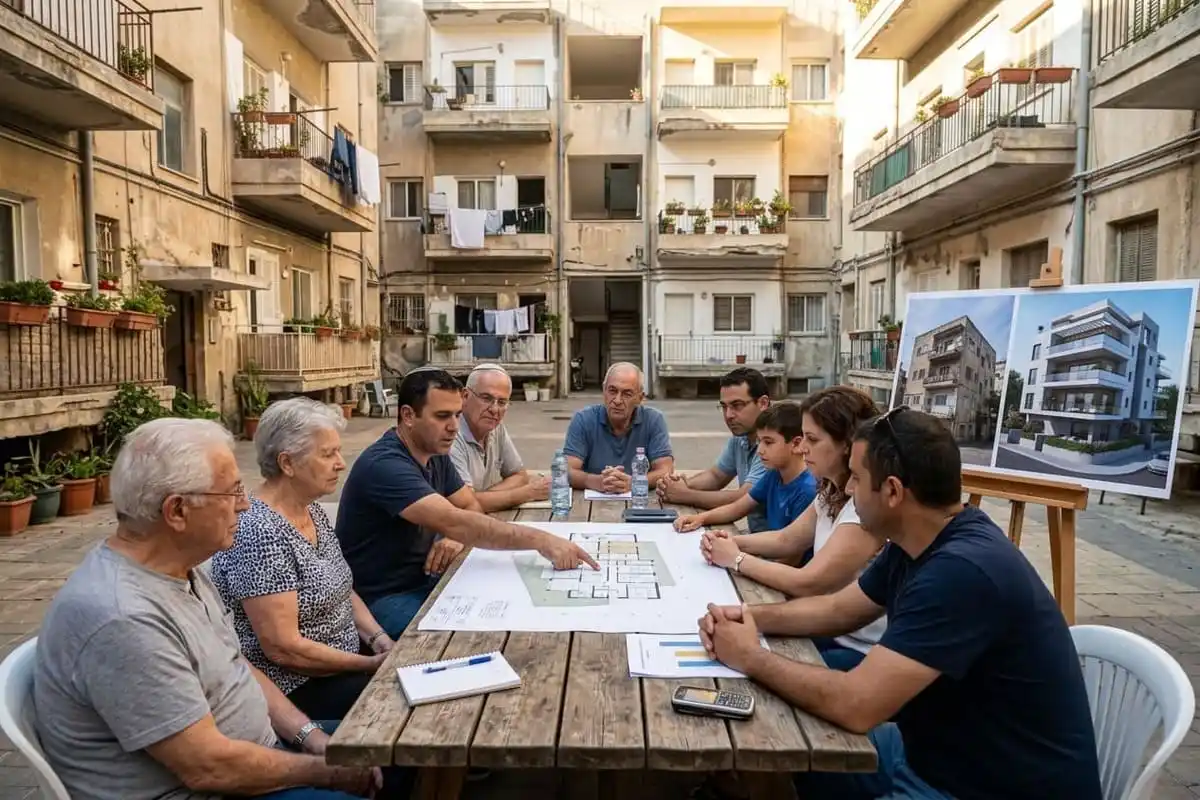
Urban Renewal and Tama 38: What Is Most Important to Know Before Signing
The developer wants you to sign quickly. That is precisely why you should slow down.
- The attorney appointed by the developer represents the developer – not you. Even if he is the one explaining the contract to you.
- Did you sign an unlimited power of attorney? You may have granted a stranger authority to act on your behalf regarding your property – without realizing it.
- Refusing to sign an urban renewal agreement is not always stubbornness. Sometimes it is the only way to protect yourself.
- An appropriate bank guarantee from the developer is not a special request – it is a basic condition every tenant is entitled to demand before signing.
The Offer That Seems Too Good
A developer arrives at your building with an impressive presentation: a new apartment, larger, with a safe room and balcony, and you pay nothing. You just need to sign. Sounds simple. But anyone who has been through an urban renewal project will tell you that the distance between the promise and reality can be vast – and can be measured in years.
Understanding the legal framework is the first step before discussing any offer in detail.
Three Tracks, Different Rules
Tama 38/1 is a plan for reinforcing an existing building against earthquakes – without demolition. The building is reinforced, safe rooms and balconies are added, and sometimes an elevator as well. The majority required for a decision under the Land Law (Reinforcement of Shared Buildings Against Earthquakes) is 66% of apartment owners. Important to know: Tama 38 expired on October 1, 2023, but certain local committees have declared an extension until May 2026 subject to defined conditions.
Tama 38/2 involves demolishing the existing building and constructing a new building in its place. The required majority increases to 80% of apartment owners. When a tenant refuses to sign and the refusal is unreasonable, the Supervisor of Shared Buildings has the authority to authorize an attorney to sign the agreement on their behalf.
Urban renewal is the broadest track of all: demolishing an entire cluster of buildings and constructing a new neighborhood in its place. The legal framework is the Evacuation and Construction Law (Encouragement of Evacuation and Construction Projects). Planning and obtaining permits can begin with the consent of 66% of apartment owners, but actual execution requires the consent of all tenants – and from there arises the question of the holdout tenant.
What You Must Demand Before Signing
Three things every tenant is entitled to receive before signing, which developers do not always offer on their own initiative:
A suitable alternative apartment for the construction period – you do not arrange this yourself; the developer does. He is required to bear the rental costs and ensure that the alternative residence suits your needs and geographic location.
An appropriate bank guarantee – this is the security that will protect you if the project stalls midway. Projects that have frozen due to the developer’s financial difficulties are a known phenomenon, and tenants who did not demand a proper guarantee were left with a demolished building and a difficult lawsuit to manage. The demand for a guarantee is not suspicion – it is basic prudence.
Independent legal representation – the attorney appointed by the developer is committed to the developer. Tenants who believe the project’s attorney is looking out for them may be disappointed later when they discover that certain clauses in the contract primarily served the interests of the other party.
The Holdout Tenant – Who Is He Really?
The term “holdout tenant” may sound as if it refers to a stubborn neighbor blocking everyone. The legal reality is more complex. The Supreme Court ruled in CA 3511/13 Schwartzberger v. Marin that a balance must be struck between the majority’s right to realize their property and the individual objector’s property rights – and that justified refusal never creates tort liability.
A refusal will be considered justified when, among other things, the offer is not economically worthwhile according to an independent appraiser’s opinion, adequate guarantees were not offered, alternative housing was not provided for the construction period, the tenant is elderly and was not offered the alternatives set forth in the Evacuation and Construction Law (Compensation) following Amendment 6 of 2018, or inequality was created in the compensation given to different tenants in the same building.
In contrast, a refusal aimed at extracting exceptional compensation while exploiting veto power – this is a refusal the courts treat severely. In urban renewal projects, tenants who have signed are entitled to sue the holdout for monetary damages for the harm caused to them, and such lawsuits have resulted in liabilities of hundreds of thousands of shekels and more.
The Golden Rule: Do Not Decide Quickly
An offer the developer presents as “valid for a limited time” will usually remain on the table. Pressure for a quick signature is a familiar tactic – and not a reason to forgo professional review. An appraisal, independent representation, and thorough review of the contract are the first step every tenant owes themselves before bringing a developer into their lives for many years.
Receiving an offer for an urban renewal or Tama project and want to know if the terms are fair? Ask before you commit. A real estate attorney is critical at this stage.
© Tidhar Tzur Law Firm | This article is for general information purposes only and does not constitute individual legal advice.
Need Legal Counsel?
Contact us for an initial consultation and we will find the right solution for you
Schedule a Meeting